
What If Behavior Change Doesn’t Start with Your Thoughts?
HAPPY 1st DAY OF SPRING!
With this occasion, I want to speak to what I consider to be one of the most life-changing developments—certainly in our lifetime—in our understanding of behavior.
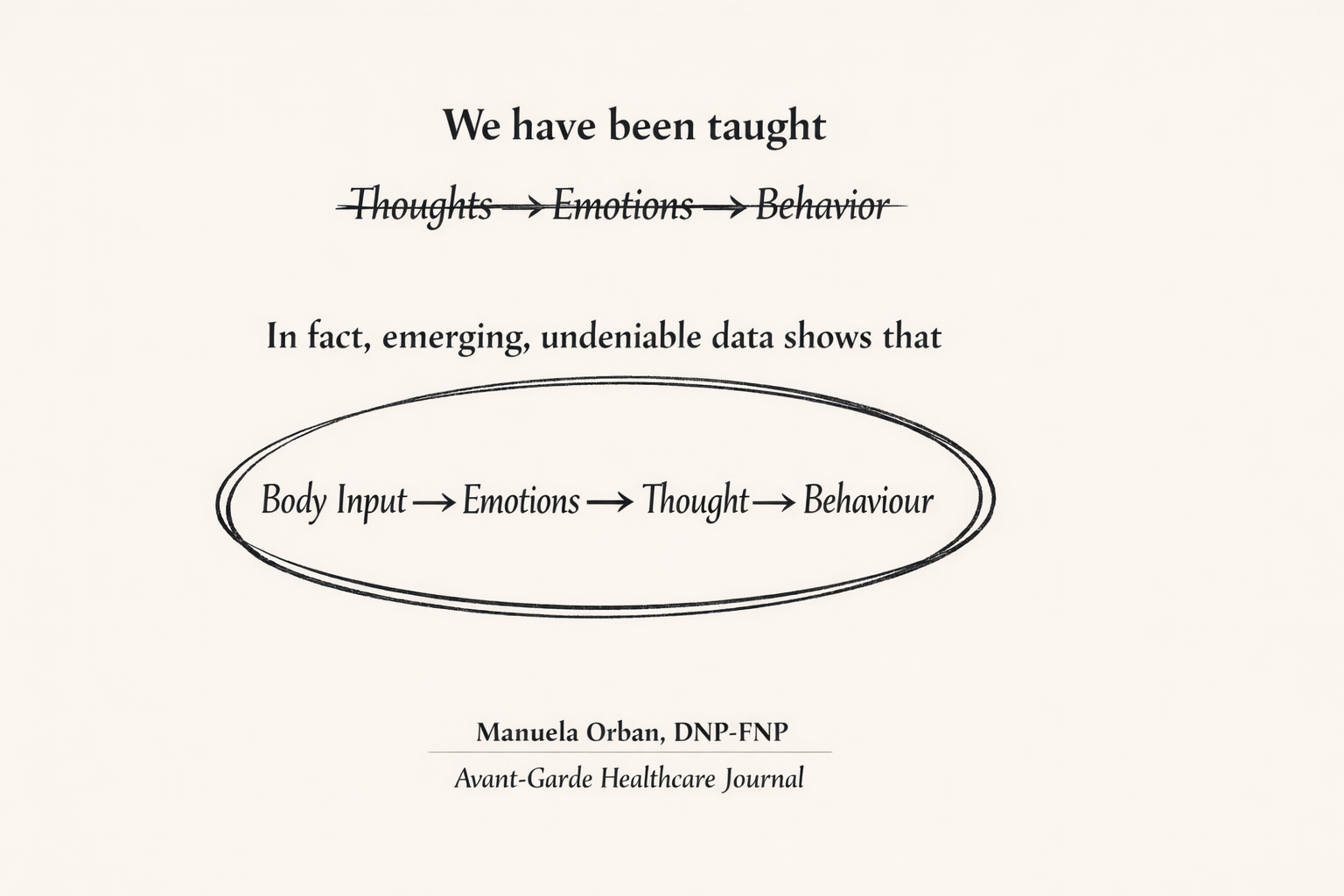
For a long time, we thought—and taught, and preached, and counseled—that thoughts create emotions, which then determine behavior. To change behavior, we must change our thoughts.
It turns out, this model is profoundly incomplete.
Emerging and undeniable research, especially in neurobiology, shows that the cycle of behavior begins with body input to the brain via the vagus nerve—heart rate, breath quality, muscle tension, stress hormone levels, inflammation markers. The limbic system of the brain (unconscious) interprets this raw data through pattern recognition, determining whether we are safe or unsafe, and generating an emotional state—fear, anger, calm, sadness.
The insula and prefrontal cortex (conscious) then register a feeling—“I feel anxious.” This awareness is given meaning in the form of a thought—“I am anxious because… I need to escape…” Behavior is then initiated based on what has been effective in the past—scrolling, eating, avoiding.
Based on this order of events, effective behavior change begins with regulating body input.
In the short term, this is achieved by signaling safety to the body—deep, slow breathing, intentional muscle relaxation, gentle rhythmic movement, etc. The long-term goal is to maintain a regulated nervous system and physiology at baseline—most of the time.
As the body shifts into a parasympathetic state, the system becomes ready and willing to follow our conscious intention—to become a trusting disciple. We regain access to self-control and true agency.
Amazingly, the Bible alludes to this process, and Dr. Anita Phillips unpacks it beautifully in her book The Garden Within, through an integrated lens of faith, psychology, and neuroscience. This is a transformational resource for understanding emotions, their powerful impact on every aspect of our being and life, and how to best work with them.
With love,
Manuela Orban, DNP-FNP
Avant-Garde Healthcare
Avant-Garde Health Journal
